← Academia · Versiunea în română
Translated from Romanian by Achiziții Corecte. The Romanian text is the reference version.
International conference “The involvement of private capital in the development of local communities”
Ovidiu Slimac – 27 May 2021

Public-Private Partnership

Legislation
EMERGENCY ORDINANCE no. 39 of 10 May 2018 on public-private partnership
- ISSUER: The Government
- PUBLISHED IN: Official Gazette no. 427 of 18 May 2018
Date of entry into force: 18 May 2018
This consolidated form is valid from 07 February 2020 until the selected date, 26 May 2021
Legislation – provisions
ART. 45
On the date of entry into force of this emergency ordinance, Law no. 233/2016 on public-private partnership, published in the Official Gazette of Romania, Part I, no. 954 of 25 November 2016, as subsequently amended and supplemented, is repealed.
We reproduce below the provisions of art. II-VI of EMERGENCY ORDINANCE no. 7 of 28 January 2020, published in OFFICIAL GAZETTE no. 93 of 7 February 2020:
Article II
(1) From the date of entry into force of this emergency ordinance, the Ministry of Transport, Infrastructure and Communications takes over from the National Commission for Strategy and Forecasting the following strategic investment projects:
- a) the Târgu Neamţ-Iaşi Motorway;
- b) the Ploieşti-Braşov Motorway;
- c) the Bucureşti-Craiova-Calafat-Drobeta-Turnu Severin-Lugoj Motorway;
- d) the Bucureşti-Craiova/Sofia-Timişoara/Belgrade-Cluj/Budapest high-speed railway line;
- e) the extension of the metro network through the construction of the M7 line;
- f) the construction of Bucharest South airport;
- g) the Ploieşti-Buzău-Focşani-Bacău-Paşcani-Iaşi-Suceava-Siret (Vicşani) high-speed railway line;
- h) piers no. 3 and 4 in the Port of Constanţa South;
- i) the operation of services in public-private partnership in the field of health, within a package made up of CFR hospitals;
- j) the development of the Argeş and Dâmboviţa rivers for navigation.
Legislation – provisions (1)
(2) From the date of entry into force of this emergency ordinance, the Ministry of Health takes over from the National Commission for Strategy and Forecasting the following strategic investment projects:
- a) the “Dr. Calistrat Grozovici” Multifunctional Clinic, building A and building B;
- b) the construction and operation of a national bank of blood, human plasma and stem cells;
- c) Timişoara Regional Hospital;
- d) Brăila-Galaţi Regional Hospital;
- e) Târgu Mureş Regional Hospital.
(3) From the date of entry into force of this emergency ordinance, the Ministry of Economy, Energy and Business Environment takes over from the National Commission for Strategy and Forecasting the following strategic investment projects:
- a) the Turnu Măgurele-Nicopole hydrotechnical complex on the Danube;
- b) the Tarniţa-Lăpuşteşti pumped-storage hydroelectric power plant;
- c) the construction of a factory for electric means of transport;
- d) the construction of a system of luxury resorts on the Black Sea – New Costineşti;
- e) a new ski tourist complex in the Făgăraş mountains.
(4) From the date of entry into force of this emergency ordinance, the Ministry of Agriculture and Rural Development takes over from the National Commission for Strategy and Forecasting the strategic investment project Completion of the Siret-Bărăgan main canal.
(5) From the date of entry into force of this emergency ordinance, the Ministry of Public Works, Development and Administration takes over from the National Commission for Strategy and Forecasting the strategic investment project the “Carol Davila-Universitary Medical City” Medical Complex.
Legislation – Considerations
Public-Private Partnership can be applied to develop projects in the field of
- transport (motorways, ports, railway stations, bus stations, airports, rail transport, metro, port terminals, etc.),
- health (hospitals, etc.),
- education (kindergartens, schools, etc.),
- sport,
- hotels or the environment,
in other words, any project that can be developed jointly by a public authority (the public partner) and a private partner.
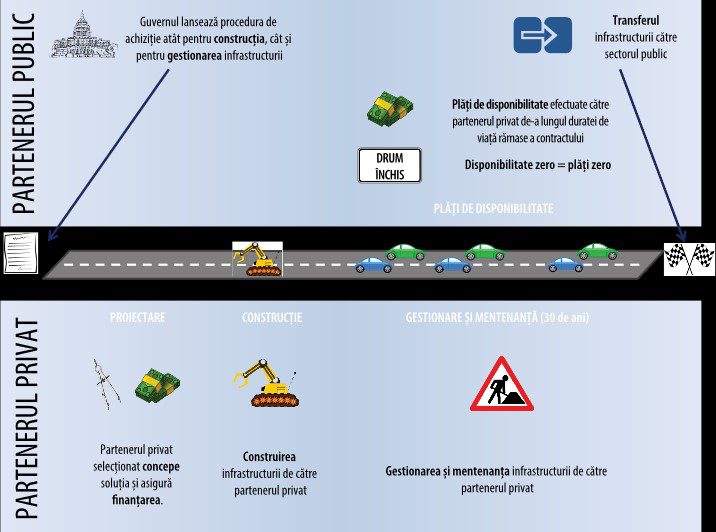
PPP scheme
Importance
The development of PPPs as an instrument becomes extremely important as the economic and financial crisis tests the capacity of public budgets to raise adequate financial resources and allocate them to important policies and specific projects.
The public sector’s interest in innovative financial instruments has grown, as has the political will to create the conditions for more efficient ways of delivering infrastructure projects, whether in the transport, social, energy or environmental sector.
To combat the economic and financial crisis, the EU and its Member States are implementing ambitious economic recovery plans aimed at stabilising the financial sector and limiting the effects of the recession on citizens and the real economy.
Investment in infrastructure projects is an important means of ensuring the continuity of economic activity during the crisis and of supporting a rapid return to sustainable economic growth.
PPPs can be effective means of delivering infrastructure projects, providing public services and innovating in general, in the context of these economic recovery efforts. At the same time, PPPs are attractive instruments for the long-term structural development of infrastructure and services, bringing together the specific advantages of the public and private sectors.
Financing
The EIB, the EU’s long-term lending institution, has actively sought to support efficient PPP mechanisms throughout Europe and, in particular, those in the field of transport infrastructure.
Since the end of the 1980s, the Bank has made available approximately EUR 30 billion in loans for PPPs.
The EIB is at the forefront of the EU’s efforts to finance innovation and enterprises.
Thanks to the EIB’s experience and its SME financing mechanism, the European Investment Fund provides the EU with an effective instrument for developing new PPPs.
In addition, the EIB, together with the Commission and the Member States, created the European PPP Expertise Centre (EPEC), which aims to strengthen the organisational capacity of the public sector to engage in PPPs through networking and policy support activities offered to its members.
The Commission works closely with the EIB and the private sector to increase the added value of EIB financing, for example by combining EU budget funds with EIB loans.
The EU market
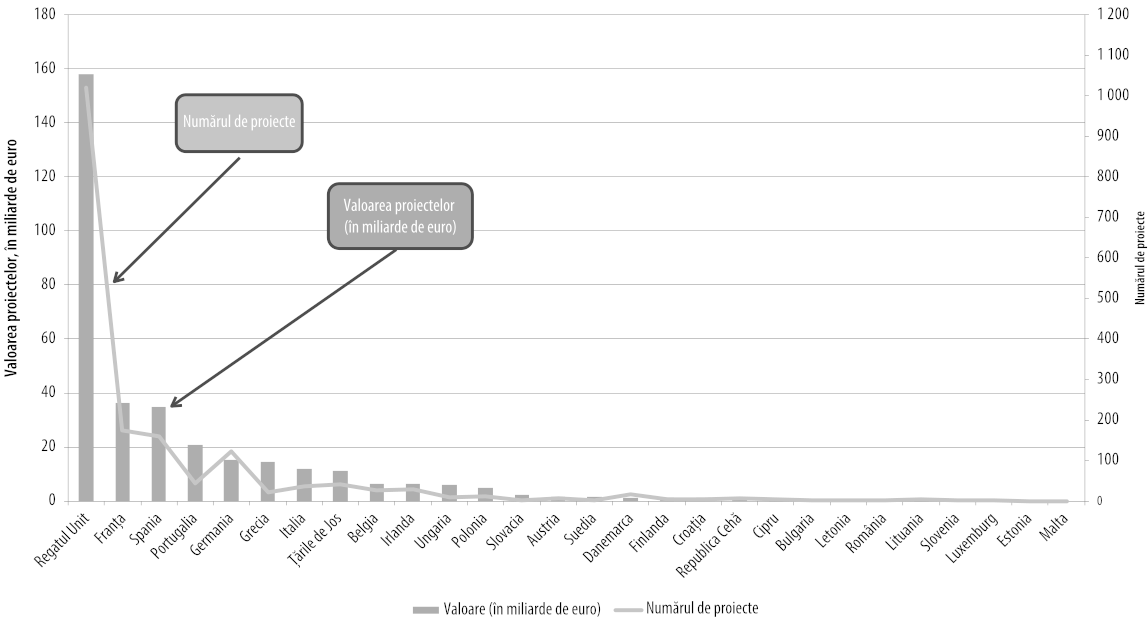
Source: European Court of Auditors, based on information provided by EPEC.
Financing – EIB
Institutional strengthening of PPP in the Western Balkans
With financial assistance from the European Western Balkans Joint Fund (EWBJF) under the Western Balkans Investment Framework (WBIF), EPEC supports beneficiary countries in the Western Balkans in their efforts to strengthen their capacity to prepare and procure sound PPPs. EPEC has received two advisory mandates:
Current assignment (2016/18): Strengthening the capacity of the public sector to undertake PPPs in the Western Balkans
This capacity-building assignment aims to disseminate PPP knowledge and good practice on the preparation and procurement of PPP projects in the Western Balkans. It is delivered with a strong focus on interactivity between EPEC and the beneficiary countries. The assignment comprises four work streams:
- Preparing a specialist review of PPP projects in the region with the aim of identifying good practices and challenges in the procedures used to identify and appraise these projects, providing an analysis and a report on the key lessons learned.
- Holding capacity-building workshops, complemented by meetings with project teams to assess the “readiness” of selected PPP projects for market launch, using the EPEC Project Preparation Tool.
- Preparing selected PPP guidance documents with a specific focus on the Western Balkans region: “PPP Suitability Analysis Guide”, “VfM Assessment Guide” and “Project Preparation and Procurement Guide”.
- Developing selected standard PPP tender documents in line with the recent EU public procurement directives (“Request for Pre-qualification”, “Request for Qualification” and “Key provisions of an availability-based PPP contract”).
Legislation – Projects
22 strategic investment projects were to be developed through PPPs, among which we mention:
- the Ploiesti – Brasov Motorway,
- the Bucuresti – Craiova – Calafat – Drobeta-Turnu Severin – Lugoj Motorway,
- the Targu Neamt – Iasi Motorway,
- the “Carol Davila – Universitary Medical City” Medical Complex,
- the Bucuresti – Craiova / (Sofia) – Timisoara / (Belgrade) – Cluj / (Budapest) high-speed railway line,
- Bucharest South Airport,
- the Siret – Baragan main canal,
- the development of the Arges and Dambovita rivers for navigation, etc.
The public authorities seemed convinced that this was the way forward for developing major transport, medical, tourism or energy infrastructure projects, so that between September 2018 and November 2019 the Government approved four substantiation studies for the following four PPPs, namely: the Ploiesti – Brasov Motorway, the “Dr. Calistrat Grozovici” Multifunctional Clinic building A and building B, the Targu Neamt – Iasi Motorway, and the construction and operation of a national bank of blood, human plasma and stem cells.
Legislation – The new legislation
In May and July 2019, two contract notices were published in the Electronic Public Procurement System (S.E.A.P.) for the projects
- the Targu Neamt – Iasi Motorway and
- the “Dr. Calistrat Grozovici” multifunctional clinic.
For the first project, two consortia from China and two from Turkey applied, and for the second, two consortia from Turkey and one from Barbados, with a company registered in Romania as subcontractor.
In February 2020, however, a new Government Emergency Ordinance was published, by which the 2018 Emergency Ordinance was amended and both the Government Decision approving the 22 PPPs and the Government Decisions approving the four substantiation Studies were repealed.
In addition, all PPP projects were transferred from the Forecasting Commission to the line ministries, namely: (i) the Ministry of Transport, Infrastructure and Communications, (ii) the Ministry of Health, (iii) the Ministry of Economy, Energy and Business Environment, (iv) the Ministry of Agriculture and Rural Development, and (v) the Ministry of Public Works, Development and Administration.
State of play
Before the Covid-19 pandemic (in January 2020), the summary situation of the 22 PPPs was as follows:
- for 12 projects, no steps of any kind had been taken,
- seven substantiation studies had been prepared, the rest being at various stages as regards the preparation and/or approval of the substantiation studies.
According to the information available as of January 2020, only three PPPs were at more advanced stages of implementation, namely:
- (i) the Ploiesti – Brasov Motorway – the award procedure was at the competitive negotiation stage, i.e. at the stage of negotiating the contractual clauses with a single tenderer;
- (ii) the Targu Neamt – Iasi Motorway – the award procedure was at the stage of qualifying the registered candidates, the deadline for submitting tenders having been extended to 06 April 2020;
- (iii) the Dr. Grozovici Multifunctional Clinic – the award procedure was at the qualification stage.
PPP – a short history
This chapter offers a historical perspective on the development of PPPs, referring first to the Roman era and the Middle Ages in France, to developments in North America, and then to an account of the development of PPPs in the 1990s, 2000-2010 and 2010-2020.
Financing PPPs through private-sector funding and recovering costs and expected profits over the life cycle of a PPP project played a decisive role in the development of OECD nations in the 19th century (water, ports, railways, electricity), especially through the concession form (Fee model) of PPPs.
Another model emerged in the United Kingdom around 1995 (PPP without concession). This model spread rapidly around the world. However, many PPPs were developed too quickly and were subsequently stopped in the 21st century, when PPPs were too financially oriented, forgetting their main purpose of serving the public interest in a sustainable manner. The chapter recounts the efforts of the international community, aware that sustainable PPPs can play a major role in the economic development of countries, to draw on the lessons learned internationally and to promote a resilient form of PPP driven by the long-term public interest and respect for the SDGs.
For PPPs to put the citizen first (PfPPP), by UNECE, where “value for people” or “value for society” are the key factors”.
PPP – schematic
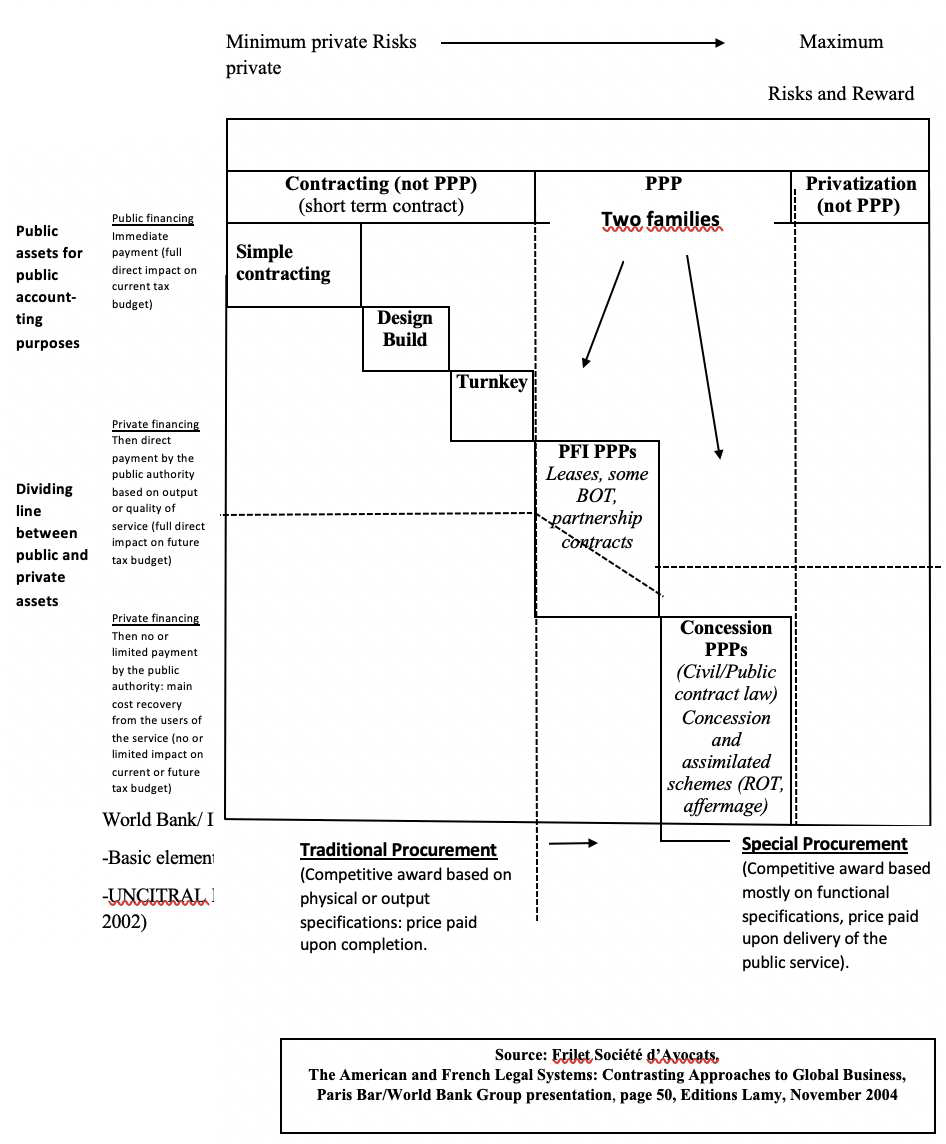
Figure 1 “Private participation in public infrastructure (PPPI)”
PPPs are neither public procurement nor privatisations
Intellectual Property & Bibliography
Author: Ovidiu Slimac
This research paper was written at the request of International Development Institute
To contact the author, please email: cluster@rovest.eu
This document is prepared for, and addressed to, the “International Development Institute”, as background material to assist them in their project Public Procurement Management / Public-Private Partnership
Reproduction and translation for non-commercial purposes are authorised, provided the source is acknowledged and the author is given prior notice and sent a copy.
Timisoara © Romania, European Union, 2021.
- Public-Private Partnerships (PPP) – a “miraculous” solution for developing Romania’s infrastructure. The situation after two years!, Author, Attorney Dr. Daniel Moreanu,
- Lexology, Public Private Partnerships in Romania, Author, Marta Popa, https://www.lexology.com/library/detail.aspx?g=411602f0-5f5d-4f47-aec3-538cc5cdbea7
- Public-private partnership in the current domestic and EU legislative context, Author, Oliviu Puie
- Amendments to the law on public-private partnership, Author, Vass Lawyers
- ARGUMENTS FOR ENCOURAGING THE IMPLEMENTATION OF PUBLIC-PRIVATE PARTNERSHIP (PPP), Author, Mihai PETRESCU – Adviser, Anti-Fraud Department, General Secretariat of the Government
- Guidebook on Promoting Good Governance in Public-Private Partnerships, UNECE 2007, p. 20
- European Investment Bank, European PPP Expertise Centre (EPEC), https://www.eib.org/epec/
- World Association of PPP Units and Professionals, Making PPPs fit the 2030 Agenda, Authors, Raymond Saner • Marc Frilet • Jean-Christophe Barth-Coullaré • David Baxter • Ziad Alexandre Hayek • Domingo Penyalver • Mateu Turró, World Association of PPP Units & Professionals, https://wappp.org/ , Bureau of the UNECE Working Party on Public-Private Partnerships, https://unece.org/ppp/bureau
- World bank Group, https://ppi.worldbank.org/en/ppi
- UNCITRAL Legislative Guide on Public-Private Partnerships
- Special report, European Court of Auditors
Thank you:
Msbc Ovidiu Slimac
Public Procurement Expert – Senior Adviser – https://www.rovest.eu – cluster@rovest.eu
Reference
Slimac, O. (2021, May 27). Parteneriatul Public Privat [Public-Private Partnership] [Presentation]. International conference “Implicarea capitalului privat în dezvoltarea comunităților locale” [The involvement of private capital in the development of local communities].
Editorial note
Published materials express the opinions and analyses of the authors who sign them and do not necessarily represent the position of Achiziții Corecte / Correct Procurement. Each author is responsible, in accordance with the law, for the content of their own contribution, including the statements made, the accuracy of information, the identification of sources, and respect for third-party rights. Publishing or making a material available does not constitute adoption or validation of all its opinions and conclusions. The materials are for information purposes and do not replace advice tailored to a particular situation. This note does not exclude liabilities that cannot be excluded by law.


You must be logged in to post a comment.