← Academia · Versiunea în română
Translated from Romanian by Achiziții Corecte. The Romanian text is the reference version.
Reflections and quotations of the European Commission’s Advisory Group on Public, Green, Innovative, Sustainable and Ecological Procurement
Dear public procurement professionals,
yesterday, 28 February 2024, the EU Corporate Sustainability Due Diligence Directive – “EU Corporate Sustainability Due Diligence Directive (CSDDD)” – failed to obtain a majority of votes.
At a crucial meeting of the EU Council, it did not receive the necessary support from the Member States and will have to be renegotiated. The rejected draft went far beyond the requirements of the German Supply Chain Act (LkSG). What is needed now is a draft with majority support, in order to have a level playing field, at least in Europe.
With the ongoing debate on the CSDDD – especially in recent months – supply chain regulation has entered mainstream discussions and gained public sensitivity. And while the future of the CSDDD may be uncertain, the journey towards sustainable supply chains continues to gain momentum and to redefine the way we do business globally.
Let us take a look around.
What follows attempts to give an overview of policy developments in public and green procurement, including the regulations on batteries, sustainable products, construction products, packaging and net-zero technologies.
- The “Batteries Regulation” aims to harmonise product requirements for batteries, minimise environmental impact, encourage reuse and recycling and provide legal certainty for the sustainable production of batteries.
- The Ecodesign for Sustainable Products Regulation requires all products on the market to comply with ecodesign requirements, introduces a digital product passport, empowers market surveillance authorities and sets priorities for certain products for regulation.
- The “Construction Products Regulation” lays down new environmental, functional and safety requirements for construction products, allows the Commission to adopt technical specifications and includes provisions on sustainability and digital product passports.
- The “Packaging and Packaging Waste Regulation” sets requirements for the recyclability, recycled content, compostability, minimisation of weight and volume, reuse and labelling of packaging, and includes reuse and refill targets.
- The “Net Zero Industry Act” aims to scale up “net-zero” technologies in the EU, support greenhouse gas emission reduction targets, ensure a secure supply of “net-zero” technologies and create favourable conditions for manufacturing.
The delegated acts permitted by the “Ecodesign Regulation” are the following:
- Technical specifications (TS): The Commission is empowered to adopt implementing acts laying down minimum green public procurement requirements in the form of technical specifications. These specifications are based on the two highest performance classes, the highest scores or the best possible performance levels to be set in the delegated acts.
- Award criteria (AC): The Commission is also empowered to adopt implementing acts laying down award criteria for public procurement. These criteria are used in the award process and may include a minimum weighting, between 15 % and 30 %, favouring the selection of the most environmentally sustainable products.
- Contract performance conditions or targets: The delegated acts may also take the form of contract performance conditions or targets. These conditions or targets require that a minimum of 50 % of the public procurement carried out at the level of contracting authorities or entities, or at aggregated national level, consist of the most sustainable products. These conditions or targets are set on an annual or multiannual basis.
It is important to note that the specific details of these delegated acts, such as the exact requirements and criteria, will be further defined in the delegated acts themselves.
The main features of the proposed Construction Products Regulation are the following:
- Renewed scope: The Regulation includes reused and 3D-printed construction products and prefabricated single-family houses.
- Commission authority: The Commission has the right to adopt technical specifications where the standardisation system is not functioning and to set product requirements.
- Environmental, functional and safety requirements: The Regulation sets new requirements for construction products as regards their environmental impact, functionality and safety.
- EU harmonisation: The Regulation aims to further harmonise construction products within the EU, while respecting the Member States’ “overriding regulatory needs” in terms of health, safety or protection of the environment, including the climate.
- Declaration of conformity: Manufacturers are required to provide a declaration of conformity with the product requirements, in addition to the declaration of performance. They may provide this information electronically.
- General sustainability requirements: The Regulation defines a list of general sustainability requirements that may be further specified by the Commission.
- Simplification and exemptions for micro-enterprises: The Regulation includes provisions on simplification and exemptions for micro-enterprises.
- Alignment with ecodesign requirements: The Regulation is aligned with the regulation on ecodesign requirements for sustainable products in terms of climate and environmental sustainability, as well as with the digital product passport.
- Minimum GPP1 requirements: The Commission is empowered to adopt delegated acts laying down minimum green public procurement (GPP) requirements for harmonised construction products. These requirements may take the form of technical specifications, award criteria, contract performance conditions or selection criteria.
- Derogations: In certain circumstances, public buyers may derogate from the provisions of the Construction Products Regulation, for example when supply is insufficient to ensure competition, when no suitable tenders have been received, when the final contract price exceeds the estimated cost by 10%, or when applying the provisions would lead to technical difficulties impossible to resolve. The use of derogations must be reported.
The different forms that green public procurement requirements can take are:
- Technical specifications (TS): GPP requirements may take the form of technical specifications, which describe the specific environmental criteria that products or services must meet. These specifications may include requirements related to sustainability, durability, reusability, recyclability and other environmental factors.
- Award criteria (AC): GPP requirements may also be included as award criteria, which are used to evaluate and compare different tenders or proposals. Award criteria may include factors such as the environmental sustainability of the products or services purchased, aspects related to innovation, energy system integration and resilience.
- Contract performance conditions: GPP requirements may be included as contract performance conditions, which specify the supplier’s or contractor’s obligations and responsibilities as regards compliance with environmental sustainability standards. These conditions may include requirements related to waste management, recycling, energy efficiency and other sustainability measures.
- Selection criteria: GPP requirements may be included as selection criteria, which are used to assess the suitability of suppliers or contractors for a particular purchase. Selection criteria may include factors such as the supplier’s or contractor’s environmental track record, its experience in implementing sustainable practices and its capacity to meet specific environmental objectives.
It is important to note that the specific forms of GPP requirements may vary depending on the policy instrument or regulation being implemented. For example, different regulations and proposals, such as the “Batteries Regulation”, the “Ecodesign for Sustainable Products Regulation”, the “Construction Products Regulation” and the “Packaging and Packaging Waste Regulation”, may each have their own requirements and specific forms of GPP.
Let us see what else is happening in the wide world: ICLEI and PROCURA+ 24
ICLEI Europe is proud to announce the finalists of the Procura+ Awards 2024 in three categories: Sustainable Procurement of the Year, Innovation Procurement of the Year and Procurement Initiative of the Year. The winners will be revealed on 13 March during a live ceremony at the Procura+ Conference 2024 in Lisbon. All finalists will receive a free ticket to the conference.
In the “Sustainable Procurement of the Year” category, the finalists are: the Norwegian Central Procurement Body, the Greater London Authority and the Dutch Custodial Institutions Agency. The Norwegian central public procurement body is nominated for developing a framework agreement on the reuse and recycling of used ICT equipment, which also included social requirements for integration into working life. The Greater London Authority sought to promote a more inclusive built environment and used sustainability expertise and social-value-based design methodologies to procure a framework for commissioning expertise for a series of built-environment projects. The Dutch Custodial Institutions Agency took a step towards fairer food procurement, giving detainees a key role in the process, setting their food satisfaction as a minimum requirement, while also taking environmental factors into account.
The finalists in the “Innovation Procurement of the Year” category are the Belgian Roads and Traffic Agency, the municipality of Bodø (Norway) and the city of Malmö (Sweden). The Belgian Roads and Traffic Agency ran a competitive dialogue aimed at designing, developing and implementing a combination of public C-ITS (Cooperative Intelligent Transport Systems and Services) services in the cloud, public data sources and commercial C-ITS applications in the context of the Belgian Mobilidata programme. The municipality of Bodø launched a call for tenders for low-emission solutions which, once awarded, became the first project in northern Norway to use zero-emission excavators.
The city of Malmö sought to make physical infrastructure, goods and services accessible to people of all ages, sizes and abilities and developed procurement criteria for several tenders based on universal design principles.
Barcelona City Council (Spain), Lisbon City Council (Portugal) and the Public Procurement Office of Lithuania are the finalists in the Procurement Initiative of the Year category.
Barcelona City Council developed a responsible public procurement strategy, in line with European policies such as the Social Economy Action Plan, to facilitate the access of social economy enterprises to public tenders. The City of Lisbon developed a sustainable public procurement management system to establish a systematic framework ensuring that all public procurement processes within the municipality are carried out in accordance with responsible, transparent, fair and environmentally friendly principles. Lithuania’s objective of reducing its carbon footprint and ensuring that every public procurement decision takes environmental impact into account led to the creation of a new sustainability unit within the Lithuanian Public Procurement Office (LPPO), which pushed for the mandatory use of green public procurement criteria and supported buyers through training and a helpdesk.
The jury, made up of Jorge Laguna Celis, Director of UNEP’s One Planet Network, Jorge Conesa, Director General of the Fair Trade Advocacy Office (FTAO), Mark Hidson, Global Director of ICLEI’s Global Sustainable Procurement Centre, and Erika Bozzay, Senior Policy Adviser in the Infrastructure and Public Procurement Division, OECD, will decide on the winners in the coming weeks.
The award ceremony at the Procura+ Conference will start on 13 March 2024 at 18:30. To attend the conference, register here.
For more information about this year’s finalists, see the Procura+ website page. There you will also find more information about previous editions of the Procura+ Awards. In 2023 there were four categories, which produced the following winners: City of Malmö, Sweden – Circular Procurement of the Year; Ministry of Economic Affairs and Climate Policy of the Netherlands – Innovation Procurement of the Year; City of Utrecht, the Netherlands – Sustainable Procurement of the Year; City of Ghent and VEB, Belgium – Procurement Initiative of the Year.
Let us render unto Caesar what is SPP’s2!
The World Sustainable Procurement Day 2024
Event by The Sustainable Procurement Pledge
| START TIME | END TIME |
|---|---|
| 21 Mar 2024, 1:00 AM EET | 22 Mar 2024, 1:00 AM EET |
I invite you to sign the Pledge now and to join the SPP Ambassadors Community at http://www.spp.earth
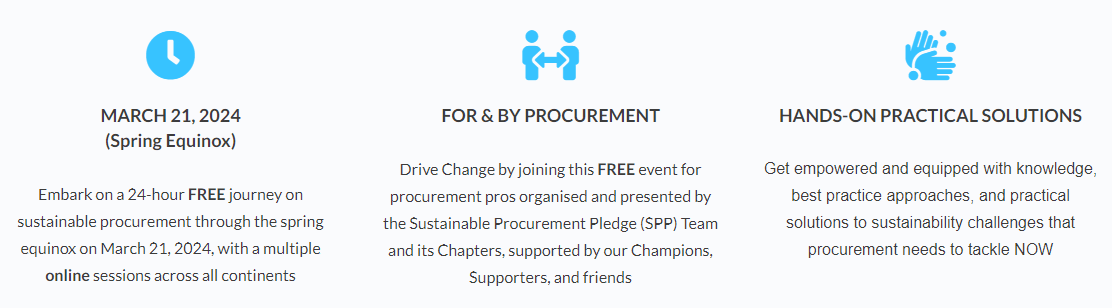
On 21 March 2024, the procurement world will come together again to celebrate the third annual edition of World Sustainable Procurement Day (WSPD), led by the Sustainable Procurement Pledge (SPP). With the motto “#collaborate2accelerate”, this day will empower and equip procurement professionals around the world on their journey towards sustainable procurement.
Building on the success and momentum of the past two years, WSPD 2024 is set to be an event with even greater impact, creating a dynamic platform for procurement professionals worldwide to share, learn and accelerate the pursuit of sustainable procurement practices.
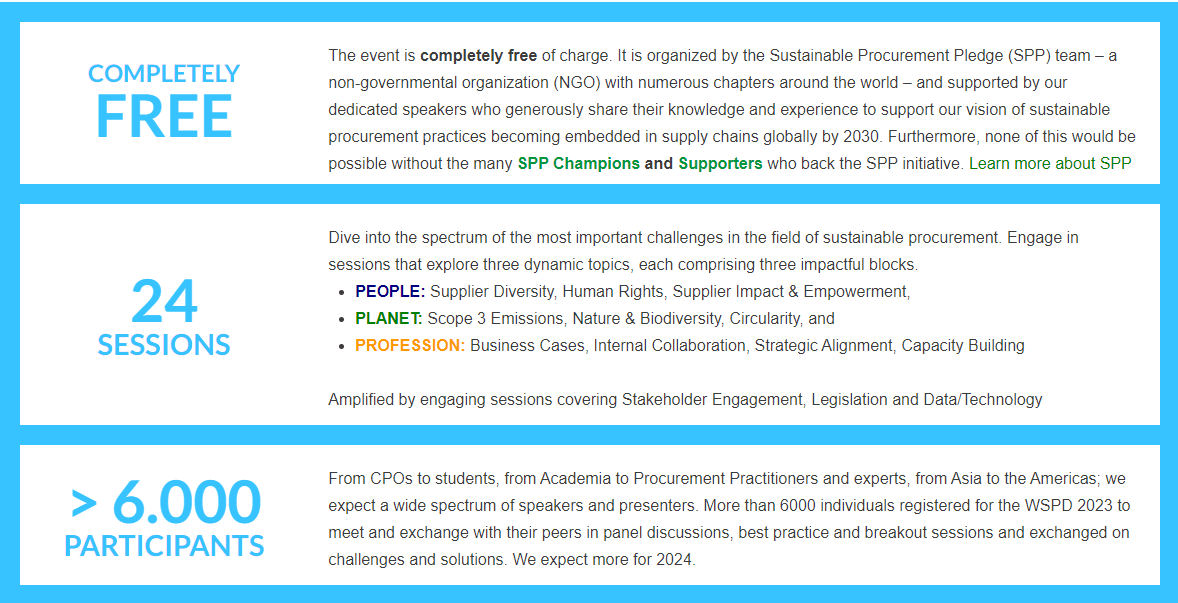
In a series of 24 sessions spanning 24 hours, participants will have the opportunity to engage with presenters and experts on various topics related to people, planet and profession. This year’s event promises to be bigger and better than ever, as it aims to attract more than 6,000 procurement professionals from around the world.
The agenda will be published in stages, but it already boasts an impressive list of inspiring speakers and influential partners, such as the World Economic Forum’s (WEF) First Movers Coalition, the World Wide Fund for Nature (WWF), the Ellen MacArthur Foundation for circularity, the Embedding Project and the Buy Social Europe B2B initiative, alongside a range of passionate thought leaders from both the SPP Champions Programme and the SPP community, which currently numbers 14,000 people.
The WSPD sessions will delve into hot topics in supply chain and procurement, including Scope 3 emissions reduction, human rights, supplier diversity and social procurement, the legislation and regulatory landscape driving global change in the procurement profession, and emerging topics such as artificial intelligence and technological advances. Addressing all sectors and industries, as well as regions around the world, these conversations are set to equip participants with a broad understanding of current and future trends in sustainable procurement. Lotte Beck, CSM Team Lead, EcoVadis, who took part last year, praised the event for: “a great variety of topics and speakers, good that you could drop in and out. I liked that it was 100% global”.
WSPD is not just another conference or event – it builds on the movement that the Sustainable Procurement Pledge (SPP) team embarked on in 2019. Their aim is to transform current procurement practices for the benefit of people and our planet. “World Sustainable Procurement Day is THE annual occasion that gives procurement professionals the knowledge and tools they need. It is our flagship event, where we connect and move forward to accelerate our collective efforts and establish responsible sourcing practices,” said Thomas Udesen, one of the co-founders of SPP and Chief Procurement Officer of Bayer.
“Collaboration is essential to accelerate positive impact for our planet and for future generations,” said Bertrand Conquéret, co-founder of SPP and CPO of Henkel. “As the proverb says: ‘Alone we can do so little – together we can do so much’, I cordially invite you to join the SPP team on 21 March 2024 and become part of the global movement for sustainable procurement!”
In addition to sharing knowledge on current topics, WSPD is also an excellent moment to set additional priorities for the coming year. This year it will again be hosted virtually, which makes it accessible from all over the world.
Participation in the SPPD is completely free and can be accessed via the following link: https://spp.earth/wspd/ .
“In the dynamic landscape of responsible procurement, we face numerous challenges that affect both us and our businesses. The scale of these challenges can be overwhelming, making prioritisation a complex task. Ideally, your company’s sustainability strategy and enterprise risk management system should provide guiding principles. Ideally, there should be a single sustainability and risk register, forged through collaborative efforts, with procurement playing an essential role in shaping this strategy, given the strategic importance of the supplier ecosystem. This ambitious task requires chief procurement officers, procurement advisers (CPOs) to position themselves at the top of the leadership triangle, working closely with chief sustainability officers and supply chain leaders for internal alignment. It is imperative to move from an exclusive focus on cost and value to a comprehensive approach that encompasses supplier development, deep interactions and a shared mindset for the strategic supplier community.
In this context, World Sustainable Procurement Day (WSPD) becomes essential, focusing on People, Planet and Profession – a delicate balance involving supplier diversity, human rights, and supplier impact and empowerment. Navigating the complexity of measuring and understanding “Scope 3” impact across the entire value chain requires collaborative efforts. No one has all the answers, but through sharing, listening and collaborative engagement, we can collectively improve our approach to these challenges.
Consider the context of the World Economic Forum’s recent annual risk report, in which chief executives identified the top three risks for the next two years:
- Misinformation and disinformation.
- Extreme weather events.
- Societal polarisation.
This is the reality we are in, and CPOs must navigate it with agility and foresight. The challenge is dynamic, and linear extrapolations will not suffice. Instead, we must build “what if” scenarios, recognising that the landscape is constantly evolving.
Leadership, transparency and clear communication are paramount. Recognise that no one can walk this path alone; it requires a collective effort. Global teams with diverse backgrounds, cultures and ambitions must align with your agenda. Openness to learning, exchanging ideas, playing in tandem and active listening become the cornerstone of progress.
No one has all the answers, and having everything ready is an unrealistic expectation. Embrace openness, a willingness to learn and a spirit of collaboration. Together, as a community that transcends divisions between companies, cultural divides and diverse backgrounds, we can draw up a plan, set priorities and make it all happen. This is exactly the objective of the SPP Champions Programme, as well as of the wider activities of the SPP network, such as our chapters and global ambassador meetings.
On this journey, we are all in it together.
Let us recognise the challenges, but also commit to act. As a united community, we have the power to bring about meaningful change. I propose that we come together for WSPD and use this event as a collaborative forum where we can share best practices and innovative solutions, and collectively chart a course towards a sustainable and resilient future. By pooling our expertise, experiences and visions, we can create a blueprint for success that goes beyond individual companies and transcends cultural and organisational boundaries. Together, let us turn challenges into opportunities and make a lasting impact on our collective journey.”
Kind regards,
Henrik Larsen
Chair of the SPP Champions Programme”
UPDATE ON THE ACTIVITIES OF THE ADVISORY GROUP (January 2024)
Organisation: ICLEI
Key publications
- La contratación pública ayuda a impulsar la transición circular en Europa. EYS Municipales
- Transforming the food system: Is public procurement the key to change?. Support Europe
- Big Buyers Working Together hilft offentlichen Einkäufern. Kleine Kniffe
- Solutions brochure for public procurement in smart cities: Smart City Market 2023
- The European Public Mosaic (EPuM), ICLEI contribution: “Public procurement: a strategic tool for a green, inclusive and innovative Europe”.
Procura+ Awards
During 2023, the Procura+ Awards 2024 were launched, consisting of 3 categories: Sustainable Procurement of the Year, Innovation Procurement of the Year and Procurement Initiative of the Year. They highlight sustainable, circular and innovative procurement and tendering procedures and give visibility to the most dynamic, forward-looking and innovative public authorities and their initiatives. The winners and finalists of the Procura+ Awards 2024 will be announced at the Procura+ Conference 2024, to be held in Lisbon on 13 and 14 March 2024.
Recent initiatives and developments
Big Buyers Working Together
The third edition of the Big Buyers Initiative was launched by the European Commission, DG GROW, in March 2023 to support collaboration between public buyers with strong purchasing power and to promote wider use of strategic public procurement for innovative and sustainable solutions. This 4-year project consists of 10 communities of practice, of which ICLEI facilitates 4: Sustainable solar panels, Social procurement, Heavy-duty electric vehicles and the New European Bauhaus. The consortium consists of ICLEI, Eurocities and BME.
Public procurement dialogues
On behalf of the European Commission, DG GROW, ICLEI, together with PricewaterhouseCoopers, is organising workshops in the 27 Member States to develop a dialogue on the use of strategic (green, social and innovation) public procurement. The aim of the workshops is to unlock the full potential of public buyers to add value in the context of national and European policy objectives and to encourage coordination and cooperation at European level to create the necessary synergies between Member States. Five in-person workshops were already organised in the following Member States in 2023: Belgium (23 May), the Czech Republic (12 June), Cyprus (13 September), Malta (18 October) and Portugal (24 November), and an online workshop took place in Greece (26 and 27 September).
Professionalisation of Public procurement
ICLEI is working with the national government of Cyprus to professionalise the public procurement workforce. The reform of the public procurement sector will ensure the availability of adequate knowledge and expertise for green, social and innovative public procurement and will be aligned with EU policies. ICLEI is developing a suite of training materials to promote the professionalisation of public procurement in Cyprus.
Supported by the Government of Belgium, the second edition of the International Working Group on Ethical ICT Procurement, which brings together the most important public IT buyers as a means of exchange, stocktaking, discussion and identification of actions for a new generation of ethical IT procurement, organised four workshops and a webinar in 2022. The workshops explored the subject and the related obstacles. The final report was drawn up at the beginning of 2023.
ICLEI continues to co-chair the Sustainable Public Procurement (SPP) Programme of the United Nations One Planet Network (OPN), together with UNEP, Rijkswaterstaat and the Environmental Development Centre of the Ministry of Ecology and Environment, PRC. The Programme identified construction as one of the three priority sectors for intervention and therefore decided to launch, in collaboration with the Global Alliance for Buildings and Construction, a flagship initiative on “Mainstreaming circularity in the construction sector through sustainable public procurement”. This programme responds directly to the Global Strategy for Sustainable Consumption and Production (2023-2030) and is a key element of the 10YFP results framework (2023- 2024), adopted by the 10YFP Board in December 2022 to kick-start the implementation of the strategy through partnerships and action-oriented approaches.
EC training on GPP
Between December 2021 and December 2024, ICLEI (on behalf of the EC) was tasked with developing an ambitious training programme to professionalise and scale up GPP across the EU. The modules of the GPP training toolkit are available online. The training is delivered by local practitioners in the following EU Member States: Cyprus, the Czech Republic, Estonia, Greece, Hungary, Lithuania, Portugal, Romania and Slovakia. Each national training programme consists of four introductory sessions and one specific session covering GPP aspects of specific relevance to the country concerned, giving participants the chance to apply what they have learned between modules and to develop their knowledge through practical tasks on all the key aspects of GPP.
EU Helpdesk for global public partnerships
On behalf of the European Commission, ICLEI manages the EU Helpdesk for global public partnerships. The helpdesk answers requests for information from all EU Member States on global public procurement and (since 2022) on socially responsible procurement, provides case studies, organises webinars and shares information on the latest public procurement developments in Europe.
CityLoops
CityLoops is a four-year EU-funded project coordinated by ICLEI, focusing on two waste streams: organic waste and construction and demolition waste, including soil. The project ended in September 2023. Within the project, each of the partner cities implemented circular demonstration projects. They were helped by the circular procurement experts of Rijkswaterstaat (RWS) and ICLEI to identify how and which procurement activities could be used to strategically support the CityLoops demonstration actions, such as procuring demolition audits or services for the collection and recovery of bio-waste. The cities of Seville, Apeldoorn, Bodø and the Copenhagen region developed procurement guidelines to support their own activities. To exchange circular procurement best practices between cities and to build capacity, ICLEI facilitated a series of workshops from March 2022. The final result of this activity was a circular procurement handbook, intended to inspire and guide procurement professionals, local and regional European public authorities of all sizes, policy makers – as well as private entities wishing to learn more about current procurement practices – to use purchasing power in their transition to a circular economy. The handbook provides tools to establish the necessary conditions for both internal and external factors, including stakeholder engagement and knowledge creation, to facilitate the effective implementation and success of a circular procurement project. In addition, it offers practical guidance for implementing the project. This includes examples and tools for incorporating circular procurement practices during pre-tender, tender and post-tender activities. Finally, it presents methods for ensuring the scalability and mainstreaming of these activities as a new norm within an organisation. The handbook can be found here.
COACH (in the Romanian text: “ANTRENOR”)
The COACH project aims to facilitate collaboration between farmers, consumers, local administrations and other actors to scale up short agri-food chains, rebalancing the position of farmers and including good practices in food procurement. ICLEI is developing a Farm2Fork toolkit on food procurement, which was published in July 2022. An animated video was launched as part of the toolkit to draw SMEs’ attention to the subject of sustainable public procurement. In addition, three multi-actor dialogues were organised (two at local authority level and one at EU level). The project started in November 2020 and ended in October 2023.
SchoolFood4Change
From January 2022 until 2025, ICLEI is leading a consortium of 33 partners from 18 local and regional administrations across Europe, providing systemic solutions for healthy and sustainable food, empowering children and adolescents in and around schools to fight rising poverty and obesity. The project harnesses public procurement as a strategic tool for the transition to healthier and more sustainable school meals. SchoolFood4Change aims to have an impact on more than 3,000 schools and 600,000 children in 12 European countries. In addition to launching very ambitious tenders, all partners must implement a “Whole School Food Approach” to achieve a healthy and sustainable food culture in and around schools. In addition, in September 2022 a report on “Innovative criteria and models for procuring sustainable and healthy meals in schools” and a “mapping of the school food system” in the countries and cities involved in the project were completed.
BUS-GoCircular
ICLEI is currently developing an action plan for how policy makers at local, national and European level can boost circular construction skills through a variety of policy levers. It also includes training materials for public buyers on how they can boost circular construction skills through public procurement. This information for policy makers was disseminated through 3 EU-level events and 4 online workshops organised by ICLEI and partners during 2023.
nZEB-ready
Since February 2023, ICLEI has managed and facilitated the nZEB Ready Cities working group, made up of 14 cities from Bulgaria, Croatia, Poland, Portugal and Romania. The working group meets once a quarter to discuss how they can stimulate demand for nearly zero-energy buildings through various measures, including public procurement. An information session for interested cities took place in January 2023. During the first workshop in March, the cities gave an overview of ongoing nZEB projects, skills training programmes and related challenges. The second took place in June and focused on the role of public procurement. The third workshop, held in September 2023, gave an overview of the financial mechanisms and funding programmes that can support the development of nZEB construction skills. The fourth and final workshop took place in January 2024 and dealt with awareness-raising and stakeholder engagement.
Buy Better Food
Buy Better Food started in 2022 as a European advocacy campaign focusing on public food procurement as an important driver of the transformation of the food system towards a sustainable, healthy and fair food system in the EU. The campaign focuses on empowering subnational advocates to improve the policy framework at EU level. The “Healthy meals in schools” petition was launched in the summer of 2022 and urges European and national policy makers to guarantee sustainable school meals as part of the EU “Farm to Fork” strategy. On 11 October 2022, the Manifesto for setting minimum standards for public canteens across the EU was published. The sustainable food procurement Manifesto was developed by ICLEI through the Campaign and calls for minimum standards for public canteens across the EU, as part of the implementation of the EU “Farm to Fork” strategy.
SPIN4EIC
Started in October 2023, SPIN4EIC is a contract with the European Innovation Council on the strategic use of public procurement of innovation to open up business opportunities for EIC innovators. It aims to provide practical assistance to EIC beneficiaries to take part as tenderers in public and private innovation procurement processes, and includes providing support services for public buyers keen to purchase innovative solutions from SMEs and start-ups, as well as creating a community connecting buyers with each other and with EIC beneficiaries.
Socially responsible public procurement
On behalf of the European Commission, ICLEI is a partner in two different projects for raising awareness and building capacity on socially responsible public procurement (SRPP), which started in spring 2023. Lot 1 is carried out in collaboration with AEIDL and the Diesis network and aims to organise training courses on socially responsible public procurement in 12 EU Member States. ICLEI is responsible for organising four events, one each in Austria, Malta, Portugal and Finland respectively. Lot 2 is in collaboration with PricewaterhouseCoopers and aims to measure positive impact within SRPP. The contracting authority has confirmed the selection of 12 EU Member States.
Dipl. Eng. Ovidiu SLIMAC
Public Procurement Specialist and Expert
Notes
Reference
Slimac, O. (2024). Evoluții ale politicii în domeniul achizițiilor publice [Developments in public procurement policy]. Club Antreprenor.
Editorial note
Published materials express the opinions and analyses of the authors who sign them and do not necessarily represent the position of Achiziții Corecte / Correct Procurement. Each author is responsible, in accordance with the law, for the content of their own contribution, including the statements made, the accuracy of information, the identification of sources, and respect for third-party rights. Publishing or making a material available does not constitute adoption or validation of all its opinions and conclusions. The materials are for information purposes and do not replace advice tailored to a particular situation. This note does not exclude liabilities that cannot be excluded by law.


You must be logged in to post a comment.